FAQs
The questions people ask me most
Range, charging, cost and the build, answered from our own experience. If your question isn't here, contact me and I'll answer it.
01
Range and charging
We drove about 3,500 km through outback South Australia, on the van's very first trip, without a moment of range anxiety. A lot of the worry about range comes from what people hear rather than what actually happens on the road.
Follow the trip →Our Citroën e-Dispatch has a 75 kWh battery and an official range of up to 339 km (WLTP). In real life it's about 300 km around town and about 275 km at highway speeds. And even then, rain, a headwind or climbing hills will all reduce it.
On the routes we've driven, yes. There were more than enough places to charge. Across NSW, Victoria and South Australia, fast chargers are usually about 200 km apart.
Broken Hill. On that route the fast chargers were further apart than our campervan's range, and the country was too barren for any AC charging either. That's unusual, but it's worth checking your route before you go. The PlugShare and A Better Routeplanner (ABRP) apps show where the chargers are and help you plan your trip. For the technically curious: our van does about 275 km at open-road speeds. Broken Hill was 283 km east of Peterborough, and even if we'd made it and fully charged there, it was another 294 km south to Mildura. A charger is already scheduled on the eastern leg, and no doubt one will follow on the southern leg soon.
On a 100 kW fast charger, the van goes from 0 to 80% in around 30 to 45 minutes. On slower AC charging, a full charge takes about 6.8 hours at 11 kW, or about 11 hours and 20 minutes at 7.4 kW. On the trip, it was perfect to drive for a couple of hours, stop for a coffee or lunch while the van sat on a fast charger, and come back to a full battery.
Yes. When we stayed in caravan parks, we charged overnight on a powered site, so we woke up ready to go. Some of that charging was even free.
At home. We always charge our EVs at home unless we're travelling, and with our solar panels, home battery and the Solar Hero tariff, we don't pay anything for power.
How we electrified our home →02
Costs
About $270 for the whole 3,500 km trip, and that included some free overnight charging at caravan parks. We made 18 charging stops, and the average cost was around $15 a stop.
How charging went →A diesel 4WD towing a caravan, using 23 litres per 100 km at $1.90 a litre, would spend about $1,220 on fuel.
Prices for electric vehicles are coming down quickly, and the newer electric vans come with V2L, which makes a conversion simpler and cheaper to design. Add the much cheaper (or free) fuel and the much lower maintenance costs, and it's an easy decision.
Very little. The van only needs a service every 40,000 km or two years. Day to day, there's nothing to check except the windscreen washer fluid and the brake fluid. We carry a spare tyre under the floor, just in case.
03
The van and the build
A 2022 Citroën e-Dispatch, which we bought in 2023. It has a 100 kW electric motor, a 75 kWh battery, a 1,000 kg payload and up to 5.3 m³ of cargo space.
Explore the build →We'd bought the van for my husband's handyman work. We'd also decided to fly as little as possible, so we weren't taking regular holidays. I thought that if we converted the van into a campervan, we'd take more. My dream is to go around Australia in it. That's why electric. As for doing the conversion ourselves, that was simple: there was no such thing as an electric campervan. Neither the manufacturers nor the professional fit-out companies had caught up with the transition. They're only just starting to now.
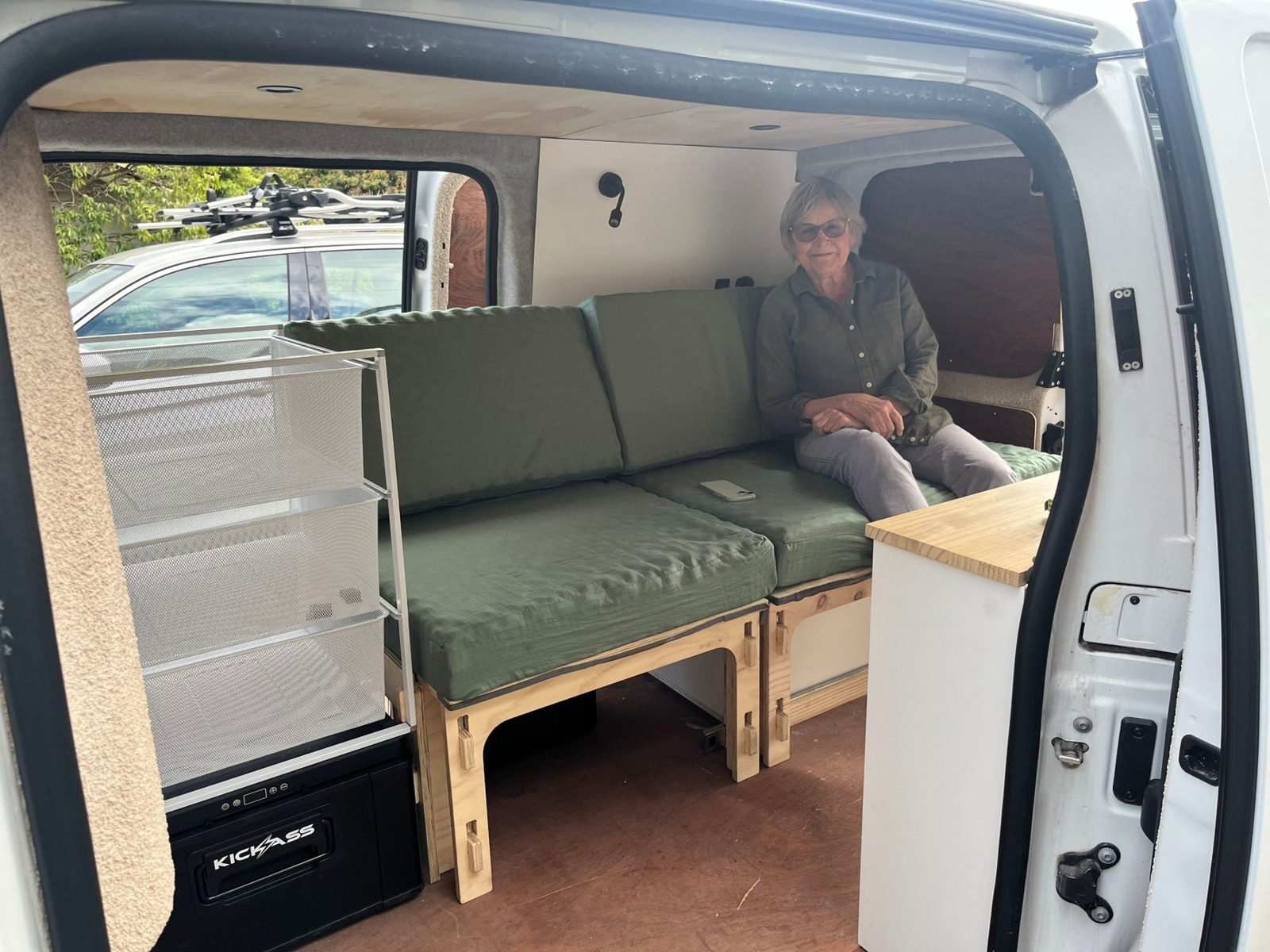
Yes, that was the point. Everything lifts out except the wheel arch and overhead storage units. Take it all out and it's a delivery van again, with fancy lights.
Under 150 kg, including the loose furnishings. Most conversions start at around 600 kg. Weight affects an EV’s range, so keeping it down was one of my main design criteria.
Weight and EV engineering →I chose lightweight, sustainable materials: cork insulation and lambswool insulation for warmth and moisture control, sustainably produced pine timber, and a food-safe, sustainably produced timber sealant.
Fit-out and materials →It's quite different, and in many ways cheaper, easier and more practical. With V2L, or a separate battery like ours, you can run a power lead out for everything, so appliances don't need to be fixed in place. Weight matters more, because it affects range. And EVs are most efficient at lower speeds, while petrol and diesel vehicles become more efficient at higher speeds. That changes how you design and drive.
V2L stands for vehicle-to-load. It lets you take 240V power straight from the vehicle's battery, through ordinary power outlets. You can plug in an induction cooktop, a kettle, a fridge and lights, just like at home. Our 2022 van doesn't have it, so we added a separate battery instead, but most new EVs now have V2L built in.
How we power the van →It depends on your vehicle. Our 2022 van doesn't have V2L, so we installed a 2.4 kWh battery that trickle-charges from the van's cigarette lighter socket, and everything runs off that. Most new EVs now have V2L power outlets built in, which is even better: you can run everything straight off the vehicle's own battery.
No. There are no gas bottles, no open flames and no fuel on board. Cooking, lighting and heating all run on electricity. It's safer, and with nothing burning in a small space, it's healthier too.
We couldn't believe how warm and snug the van was overnight, so we never needed an electric heater, even when nights on our Lake Eyre trip got down to −3°. If we did need one, it could plug into a power point. The cork and lambswool insulation did a great job.
Yes. Part of the bed lifts out, along with the fridge and shelves, which makes room for our eBikes. Leave the couch in and it becomes a day camper for bikes or surfboards. For longer camping trips, we can put a bike rack on the van's towbar instead.
Layout and modular design →They can, but many conversion companies don't yet understand how EVs differ from petrol vehicles: things like weight, efficiency at different speeds, and what V2L makes possible. If you go that way, it's worth asking them about those things.
04
Camping and travelling
No. If your electric car has V2L outlets, you can plug in an induction cooktop, a kettle, lights and a fridge at camp. We've camped with a friend who does exactly that, with a tent and a dog.
Sealed roads and well-kept dirt roads, yes. Some of the dirt roads around Lake Eyre were so poorly maintained that the van, or any normal car, couldn't drive them, so we used our friends' 4WD for those.
Read about the trip →A pleasure. Even after long stretches, I didn't feel tired at the end of the day. I put that down mainly to there being no engine vibration.
It's very unlikely. An EV has about 30 moving parts in its drive chain, compared with over 3,000 in a petrol engine. No pistons, gearbox, camshaft, crankshaft, timing belts or spark plugs. Over ten years and three EVs, I've appreciated more and more how little can go wrong, and I've only had one flat tyre in that time. We had not one problem with the campervan on its first big trip.
Yes. On our Lake Eyre trip we cooked, slept, dressed and cleaned in the van for three and a half weeks, through weather from sunny days to wind and pouring rain. We hadn't camped for decades, and it went amazingly well.
Still have a question?
Ask me about your own build
Whether you're planning a full conversion, buying an electric van, or wondering if your EV could take you camping, I'd love to help.